
Introduction: Your Clients Are Watching AI—and Wondering About Your Bill
Artificial intelligence isn’t just changing how law firms operate. It’s changing how clients think about your work. As AI tools become mainstream, clients increasingly assume that some portion of your legal work is being drafted, researched, or streamlined by software. And when that belief sets in—fair or not—it affects how they perceive your bills.
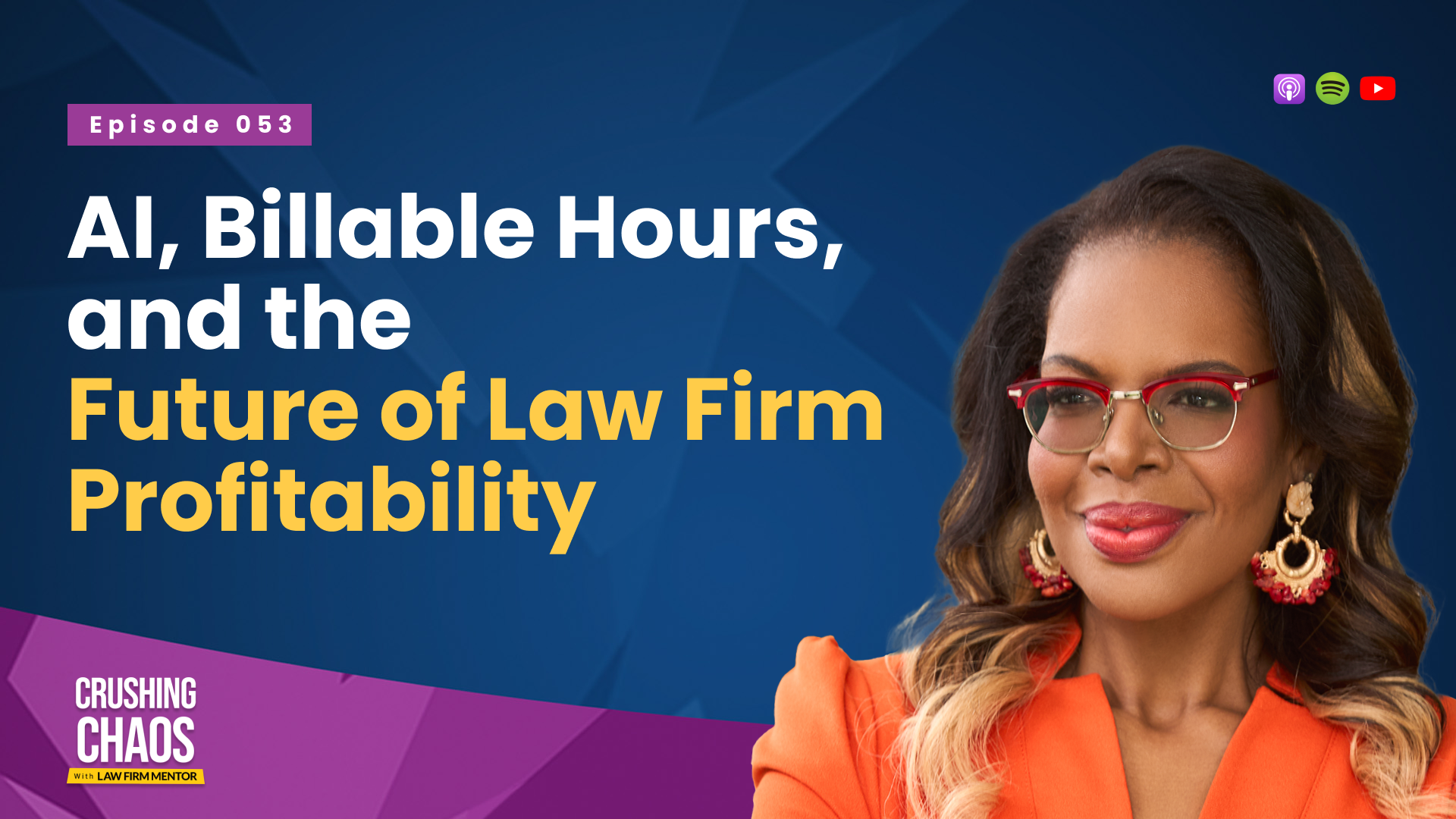
In Episode 53 of Crushing Chaos with Law Firm Mentor, Allison Williams breaks down the evolving relationship between AI, the billable hour, and your bottom line. She explains the risks, the opportunities, and the strategic shifts law firm owners must make to stay profitable while maintaining client trust.
This blog distills the core lessons so you can adapt before your clients start questioning whether they’re paying for your expertise—or for ChatGPT.
AI Is Reshaping Expectations—But It Hasn’t Replaced You
Your clients are becoming more tech‑savvy by the day. Many of them already use AI tools like ChatGPT to answer questions, summarize documents, or explore legal concepts at a surface level. When they see how quickly these tools generate output, it’s natural for them to assume that your legal work should be equally fast—and therefore less expensive.
But as Allison underscores, AI is not (and should never be) a stand‑alone substitute for lawyering. Your judgment, strategic insight, persuasion skills, and ability to interpret nuance are still what clients truly need. AI can support your work, but it cannot replace the human elements of advocacy, negotiation, or courtroom persuasion.
This means your messaging must evolve. Clients need reassurance not just about what you do, but why your involvement matters in a world where technology is accelerating.
Billable Hours Didn’t Start With Lawyers—Clients Created Them
One of the most surprising insights Allison shares is that the billable hour wasn’t a lawyer‑driven invention. It came from clients who wanted transparency. Before hourly billing, lawyers charged based on what they felt was reasonable. Sometimes that meant a client paid far less than the work required; other times it meant a windfall for the lawyer.
AI is creating a similar shift today. When clients believe technology can complete legal work faster, they begin questioning whether hourly billing still reflects value. The fear isn’t just that AI reduces work time—it’s that clients will assume you’re charging premium rates for work software produced.
This is where proactive communication becomes essential. Explain how AI fits into your process (or doesn’t). Reinforce that your value is not measured in keystrokes but in strategy, precision, and judgment.
Big Law Is Paying for AI—But Small Firms Can Benefit Faster
Large firms are pouring millions into custom AI development, proprietary databases, and enhanced tech infrastructure. Smaller law firms don’t have to shoulder those costs—but they can leverage the resulting tools.
This is one of the biggest competitive advantages small firms have right now.
Because you’re leaner and more agile, you can:
- Integrate AI tools without massive overhead.
- Move faster in adopting new technology.
- Market your efficiency and price‑sensitivity to clients.
- Highlight the personalized service clients won’t get from Big Law.
As Allison notes, agility has always been the superpower of the small firm owner—and AI only amplifies that.
Your Clients Are Becoming More Sophisticated—And More Skeptical
Clients today aren’t passive. They’re informed, observant, and increasingly curious about how much of their legal work is AI‑generated.
Allison points out that some clients have begun asking outright:
“Did my lawyer write this—or did ChatGPT?”
Whether or not AI is part of your process, you must be prepared to answer that question.
Here’s how to get ahead of client skepticism:
- Address AI directly in your engagement agreements. Spell out what AI may be used for and what remains exclusively human‑performed.
- Proactively reinforce your role as strategist. Show clients how your judgment shapes outcomes, not just documents.
- Build value into your communication. Don’t let clients guess what you’re doing—tell them.
Your success depends on being transparent, confident, and proactive—not defensive.
AI Adoption Is Uneven Across Practice Areas—And That Matters for Billing
AI has advanced rapidly in document-heavy work like discovery, contracts, due diligence, and research. That doesn’t mean it has taken over litigation, negotiation, or advisory roles.
In fact, the more human-driven your practice area, the more important it is to communicate the experience of your work—not just the output.
As Allison explains, clients perceive value based on visibility. If they understand the effort behind your negotiation, motion strategy, or courtroom preparation, they assign higher value. If they only see documents being produced, AI raises questions.
Your job is to bridge the gap between what clients see and what you do.
Taking Control of the Conversation Around AI and Your Value
AI is here to stay. The way clients interpret it—and interpret you—is what will determine your firm’s future profitability.
To stay ahead, remember:
- Your value is in your judgment, not your typing speed.
- Clients are becoming more informed, not more tolerant.
- Communication is your best defensive and offensive strategy.
- Agility is your competitive edge as a small firm owner.
- AI is a tool—not your replacement.
When you adopt this mindset, you position yourself not as someone threatened by AI, but as the strategic leader clients trust to navigate new technology intelligently.
Want to Go Deeper? Listen to Episode 53
AI isn’t just changing the legal industry—it’s reshaping how clients value your work. To understand these shifts on a deeper level, watch or listen to the full episode:
- YouTube: AI, Billable Hours, and the Future of Law Firm Profitability
- Spotify: Listen on Spotify
- Apple Podcasts: Listen on Apple Podcasts
Prefer to take action instead of just consuming content?
Book a Discovery Call with Law Firm Mentor. Let’s talk about how to future‑proof your billing, your systems, and your profitability.
Because the firms that thrive in the age of AI won’t be the ones who resist it—they’ll be the ones who lead.