
The Real Question: How Do You Pay a Law Firm Salesperson Without Breaking the Rules?
Many law firm owners reach the same moment in their growth journey: We need someone else to sell—because I can’t keep juggling it all. But the next thought comes quickly: How do I pay them without getting into ethics trouble?
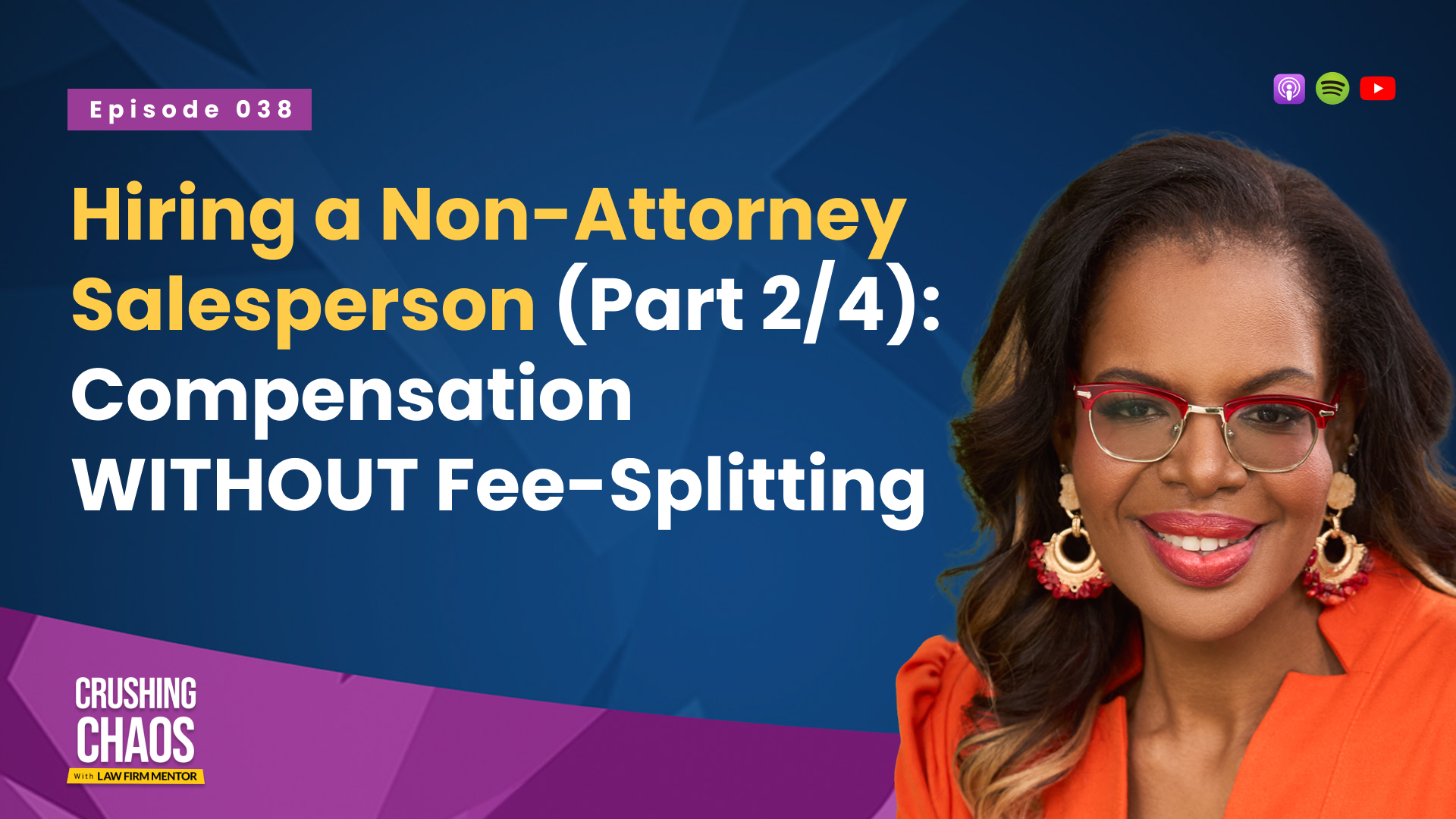
In Episode 38 of Crushing Chaos with Law Firm Mentor, Allison Williams breaks down the answer with clarity and strategy, drawing from years of coaching law firm owners through the exact same challenge.
This episode zooms in on the compensation question—one of the biggest barriers for attorneys who want the revenue lift of a dedicated salesperson but fear the ethical landmines.
This blog translates the episode’s key insights into a structured guide you can refer to as you explore hiring your first (or next) non-attorney salesperson.
Why You Can’t Use “Base + Commission” in Most States
In traditional sales industries—automotive, jewelry, luxury goods—salespeople are paid a base salary plus a percentage commission on what they sell. It’s simple, familiar, and effective.
But in law? It’s not allowed in most jurisdictions.
Allison explains that ABA Model Rule 5.4 prohibits fee-sharing with non-attorneys—outside of a few narrow exceptions that do not apply to sales roles.
That means:
- You cannot give your salesperson a percentage of a retainer.
- You cannot compensate them based on a portion of collected fees.
- You cannot structure their pay like a traditional sales job.
The good news? There’s a better, more predictable, and more sustainable way.
Why Bonuses, Not Commissions, Are the Ethical Solution
Allison shifts the paradigm: instead of a commission tied to a specific sale, you pay bonuses tied to performance outcomes over time.
This distinction matters.
A commission rewards someone for selling a specific person. It is directly tied to a fee.
A bonus rewards someone for performing their job well overall.
To stay compliant with ethics rules, your bonus structure should be based on:
- Conversion rates over a period of time.
- Collected revenue totals (not per-client earnings).
- Behavioral metrics such as follow-up consistency.
- Activity standards like CRM usage or outbound touches.
Allison emphasizes that bonuses must represent “performance in excess of minimum expectations.” In other words: the base salary pays for the job. Bonuses pay for exceptional execution.
Start With the Right Base Salary (Here’s Why It Matters)
Legal sales roles aren’t like retail or high-ticket consumer sales. The tasks reach beyond selling:
- Nurturing prospects
- Building rapport
- Passing clients efficiently to the legal team
- Following ethical communication standards
- Maintaining long-term relationships
Because the scope is broader than pure sales, the salary must reflect that. As Allison notes, this isn’t a “tiny base plus enormous commission” situation. The paycheck must sustain someone who may:
- Conduct multiple follow-ups before a sale closes
- Spend time relationship-building
- Manage data and lead tracking
A strong salary allows you to attract someone who can perform at a higher strategic level—not a transactional one.
How to Set Bonuses That Inspire Performance
To make bonuses effective and ethical, you must anchor them in firm-wide metrics, not individual sales.
Here are the metrics Allison recommends:
1. Conversion Rate Bonuses
You track:
- Number of consultations
- Number of clients retained
If the salesperson exceeds the firm’s average conversion rate, they earn a bonus.
This rewards skill, consistency, and follow-up—not one-time events.
2. Collected Revenue Benchmarks
Allison is clear: pay bonuses on dollars collected, not dollars billed, and never tied to an individual file.
This ensures:
- No per-file compensation
- No ethical risk
- A direct incentive to nurture clients who actually pay
3. Behavior-Based Incentives
Some behaviors statistically correlate to closed clients, such as:
- Timely follow-ups
- CRM engagement
- Consistent communication
If someone does the behaviors, the outcomes follow.
The Hidden Math: Why You Can Afford a Non-Attorney Salesperson
Many attorneys panic: “How can I afford this salary?” Allison reframes the question entirely.
If you’re a solo owner doing your own consultations, you’re spending hours each week selling that could instead be spent:
- Billing
- Leading
- Marketing
- Managing your team
When a salesperson frees up 10 hours each week and you bill even 8 of them at $500/hour, you generate:
$4,000/week → $208,000/year
That alone pays for the role.
And that’s before we even account for:
- Better conversion rates
- Faster scheduling
- More consistent follow-up
- Fewer leads slipping through cracks
Allison notes that this is exactly why most firms profit dramatically after hiring the right salesperson.
The #1 Thing to Incentivize: Follow-Up
Selling legal services rarely happens in one call.
Many clients:
- Need time
- Need reassurance
- Need reminders
When you incentivize follow-up, you dramatically increase the number of “slow close” clients.
Allison shares that many firms capture an additional 15% of clients simply by following up consistently. That can mean:
- 4 more clients per month
- $20,000 more revenue
- $240,000/year in previously lost opportunities
And because bonuses can be tied to conversion rate and collected revenue—not per-person commission—this remains fully ethical.
Bringing It All Together
Compensating a non-attorney salesperson can feel intimidating, but the truth is this:
You can pay ethically, profitably, and predictably—without fee-splitting.
Bonuses tied to firm metrics, a competitive salary, and clear performance standards give you everything you need to grow without crossing any ethical boundaries.
And when you hire the right person, you don’t just increase revenue. You take back your time, step deeper into your CEO role, and create a business that runs with more consistency, predictability, and peace.
Ready to Dive Deeper? Watch or Listen to Episode 38
Watch on YouTube: https://www.youtube.com/watch?v=Q1NNH07RjH0&t=1s
Listen on Spotify: https://open.spotify.com/episode/2laqCz5NhpSFybcHX0SBxP?si=TE6sGLWfRYKhjjpm8O9AmQ
Listen on Apple Podcasts: https://podcasts.apple.com/us/podcast/hiring-a-non-attorney-salesperson-part-2-4/id1497474051?i=1000717650690
If you’re ready to crush chaos, tighten your sales system, and make your hiring decisions with confidence, this episode is a must.
Or take the next step:
Book a discovery call with Law Firm Mentor and learn how our team can help you hire, train, and scale with clarity and support.